- Home |
- About |
- Contact Us |
- Privacy |
- Newsletter |
- Shop |
- Donate
How to do Function Tables
Support Page

Find out how to do Function Tables here!
This page shows you how to answer a range of different questions involving function tables.
Find out the 3 main types of question you may be asked and how to solve them in minutes!
Test your skills with some of our function table worksheets or quizzes.
What is a Function Table?
Before you learn how to do function tables you need to know what they are and how they work.
If this is the case then take a look at our what is a function table support page.
Find out about different types of function table and how they work.
Look at some examples of different function tables with one-operation and two-operation rules and functions.

How to do Function Tables - Types of Questions

Function table questions fall into 3 different categories:
- Find the Output if we know the Input and the Rule (or Function).
- Find the Input if we know the Output and the Rule (or Function).
- Find the Rule (or Function) if both the Inputs and Outputs are known.
Finding the rule (or function) is usually the hardest of the three questions to work out, especially if the rule involves more than one operation.
We will show you how to solve each of the three categories using worked examples below.
How to Do Function Tables:
1) Find the Output when we know the Rule and the Input
Example 1A) Fill in the missing outputs in this input/output table.

We can see that the rule for the function is 'Multiply by 5'.
This means that we need to multiply each input by 5 to find the output.
Looking at the inputs we have, this gives us:
- input 4 → 4 x 5 = 20 (output)
- input 0 → 0 x 5 = 0 (output)
- input 3 → 3 x 5 = 15 (output)
- input 5 → 5 x 5 = 25 (output)
So our completed table of outputs gives us:

Example 1B) Fill in the missing outputs in this input/output table.

We can see that the rule for the function is 'Double and add 1'.
This means that we need to double each of the inputs then add 1 to find the output.
Looking at the inputs we have, this gives us:
- input 13 → (13 x 2) + 1 = 26 + 1 = 27 (output)
- input 11 → (11 x 2) + 1 = 22 + 1 = 23 (output)
- input 19 → (19 x 2) + 1 = 38 + 1 = 39 (output)
- input 25 → (25 x 2) + 1 = 50 + 1 = 51 (output)
- input 0 → (0 x 2) + 1 = 0 + 1 = 1 (output)
So our completed table of outputs gives us:

Here are some more examples how to do function tables of this type which use algebraic functions.
Example 1C) Fill in the missing outputs in this input/output table.

We can see that the rule for the function is \[ f(x) = 3x - 1 \].
This means that we need to multiply the input by 3 then subtract 1 to find the output.
Looking at the inputs we have, this gives us:
- input 6 → (6 x 3) − 1 = 18 − 1 = 17 (output)
- input 1 → (1 x 3) − 1 = 3 − 1 = 2 (output)
- input 4 → (4 x 3) − 1 = 12 − 1 = 11 (output)
- input 9 → (9 x 3) − 1 = 27 − 1 = 26 (output)
- input 10 → (10 x 3) − 1 = 30 − 1 = 29 (output)
- input 50 → (50 x 3) − 1 = 150 − 1 = 149 (output)
So our completed table of outputs gives us:

Example 1D) Fill in the missing outputs in this input/output table.

We can see that the rule for the function is \[ f(x) = (x -2)^2 \].
This means that we need to subtract 2 from the value of the input and then square the result to find the output.
Looking at the inputs we have, this gives us:
- input 8 → (8 − 2)2 = 62 = 36 (output)
- input 3 → (3 − 2)2 = 12 = 1 (output)
- input -2 → (-2 − 2)2 = (-4)2 = 16 (output)
- input 5 → (5 − 2)2 = 32 = 9 (output)
- input 6 → (6 − 2)2 = 42 = 16 (output)
So our completed table of outputs gives us:

How to Do Function Tables:
2) Find the Input when we know the Rule and the Output
Example 2A) Fill in the missing inputs in this input/output table.

We can see that the rule for the function is 'Divide by 4'. As a flow chart, the rule looks like this

This means that we need to divide each input by 4 to find the output.
However, because we know the output already we actually need to use the inverse operation to find the input.
The inverse of dividing is multiplying.
So the inverse of dividing by 4 is multiplying by 4.
So this gives us a new rule to work back from the output to find the input.

Looking at the outputs we have, this gives us:
- (input) 8 ← x 4 ← 2 (output)
- (input) 20 ← x 4 ← 5 (output)
- (input) 4 ← x 4 ← 1 (output)
- (input) 24 ← x 4 ← 6 (output)
- (input) 0 ← x 4 ← 0 (output)
- (input) 36 ← x 4 ← 9 (output)
So our completed table of inputs gives us:

Example 2B) Fill in the missing inputs in this input/output table.

We can see that the rule for the function is 'Multiply by 3 then Subtract 1'. As a flow chart, the rule looks like this

This means that we need to multiply each number by 3 then subtract 1 to find the output.
However, because we know the output already we actually need to use the inverse operation to reverse this process to find the input.
The inverse of multiplying by 3 is dividing by 3.
The inverse of subtracting 1 is adding 1.
So this gives us a new rule to work back from the output to find the input.

You will notice in the flow chart that we need to do the operations in reverse order, so we need to add 1 first, then divide the result by 3.
Looking at the outputs we have, this gives us:
- (input) 9 ← ÷ 3 ← 27 ← + 1 ← 26 (output)
- (input) 12 ← ÷ 3 ← 36 ← + 1 ← 35 (output)
- (input) 1 ← ÷ 3 ← 3 ← + 1 ← 2 (output)
- (input) 14 ← ÷ 3 ← 42 ← + 1 ← 41 (output)
- (input) 7 ← ÷ 3 ← 21 ← + 1 ← 20 (output)
- (input) 20 ← ÷ 3 ← 60 ← + 1 ← 59 (output)
So our completed table of inputs gives us:

Here are some more examples how to do function tables of this type which use algebraic functions.
Example 2C) Fill in the missing inputs in this input/output table.

We can see that the function is defined as \[ f(x) = 7x - 4 \]
This means that the rule for the function is 'Multiply by 7 then Subtract 4'. As a flow chart, the rule looks like this

This means that we need to multiply each number by 7 then subtract 4 to find the output.
However, because we know the output already we actually need to use the inverse operation to reverse this process to find the input.
The inverse of multiplying by 7 is dividing by 7.
The inverse of subtracting 4 is adding 4.
So this gives us a new rule to work back from the output to find the input.

You will notice in the flow chart that we need to do the operations in reverse order, so we need to add 4 first, then divide the result by 7.
Looking at the outputs we have, this gives us:
- (input) 11 ← ÷ 7 ← 77 ← + 4 ← 73 (output)
- (input) 6 ← ÷ 7 ← 42 ← + 4 ← 38 (output)
- (input) 9 ← ÷ 7 ← 63 ← + 4 ← 59 (output)
- (input) 1 ← ÷ 7 ← 7 ← + 4 ← 3 (output)
- (input) 12 ← ÷ 7 ← 84 ← + 4 ← 80 (output)
- (input) 3 ← ÷ 7 ← 21 ← + 4 ← 17 (output)
So our completed table of inputs gives us:

Example 2D) Fill in the missing inputs in this input/output table.

We can see that the function is defined as \[ f(x) = {1 \over 3} (x + 2) \]
This means that the rule for the function is 'Add 2 to the input and then Multiply by ⅓'.
However, if we are multiplying a number by ⅓ then it would be easier for us to think of this as dividing it into 3 equal groups (or just dividing by 3).
As a flow chart, the rule looks like this

This means that we need to add 2 to the input and then divide the result by 3 to find the output.
However, because we know the output already we actually need to use the inverse operation to reverse this process to find the input.
The inverse of adding 2 is subtracting 2.
The inverse of dividing by 3 is multiplying by 3.
So this gives us a new rule to work back from the output to find the input.

You will notice in the flow chart that we need to do the operations in reverse order, so we need to multiply by 3 first, then subtract 2 from the result.
Looking at the outputs we have, this gives us:
- (input) 25 ← − 2 ← 27 ← x 3 ← 9 (output)
- (input) 13 ← − 2 ← 15 ← x 3 ← 5 (output)
- (input) 7 ← − 2 ← 9 ← x 3 ← 3 (output)
- (input) 19 ← − 2 ← 21 ← x 3 ← 7 (output)
- (input) 1 ← − 2 ← 3 ← x 3 ← 1 (output)
So our completed table of inputs gives us:

How to Do Function Tables:
3) Find the Rule (or function) when we know the Input and Output
When finding the rule for a function table, there are usually two types of function:
- a single operation rule
- a two operation rule
Finding a Single Operation Rule
When you are finding a single operation rule, there are two types of rule that are commonly found:
- an addition or subtraction rule (example 3A)
- a multiplication or division rule (example 3B)
We have included an example of each rule below.
Example 3A) Fill in the single operation rule in this input/output table.

We can see that the function table has 6 inputs and 6 outputs.
In this case, the outputs are all smaller than the inputs so the rule is likely to either be a subtraction or a division rule.
Our first test is to see if the single operation rule is an addition or subtraction rule is to find the difference between the inputs and outputs.
We can add an extra column to the table to show the difference between the inputs and outputs.

We can see that in each case, the output is 9 less than the input.
This shows us that the rule must be 'Subtract 9'.

Example 3B) Single Operation Rule. Fill in the rule in this input/output table.

We can see that the function table has 6 inputs and 6 outputs.
In this case, the outputs are all larger than the inputs so the rule is likely to either be an addition or a multiplication rule.
Our first test is to see if the single operation rule is an addition or subtraction rule is to find the difference between the inputs and outputs.
We can add an extra column to the table to show the difference between the inputs and outputs.

We can see that there is no clear pattern with the way that the inputs are related to the outputs by looking at the difference between the input and corresponding output.
Our next step is to see if the rule is related to multiplication or division by looking at how many times the inputs 'goes into' the output, or dividing the output by its input.

Now we can see that in every case, the output is equal to 3 times the input (the output divided by the input is always equal to 3).
This shows us that the rule must be 'Multiply by 3' or 'x 3'.

Here are some harder examples of how to do function tables when the function is unknown and has a two-operations rule.
Finding a Two-Operations Rule
When you are finding a rule with two operations, there are two types of rule that are commonly found:
- an addition or subtraction followed by a multiplication or division rule
- a multiplication or division followed by an addition or subtraction rule
Finding a two-operations rule can be quite difficult, so we have used examples where the input starts at 0 and increases by 1 each time.
Example 3C) Two Operations Rule. Fill in the rule in this input/output table.

The analysis that we tried before in Example 3B will only work if the rule is a single operation rule so we need to try something else!
You will notice that in this case, the inputs themselves all follow a pattern and increase by 1 each time.
Because of this, we can also look at how the outputs are changing each time.
We can see that the outputs start at 1 and are increasing by 2 each time.

Because the outputs are increasing by 2 (as the inputs increase by 1) it means that one of the rules is 'Multiply by 2'. This is beacuse the outputs are increasing twice as much as the inputs.
We now just need to look at one of the inputs and outputs to find the second rule.
The first input is 0. The first output is 1.
If the first rule is 'Multiply by 2', then 0 x 2 = 0.
To get an output of 1, we just need to add 1.
So it looks like our rule is 'Multiply by 2 and then Add 1'.
We can test this by looking at the second input in the table which is 1.
1 x 2 + 1 = 3 which is the second output so it looks like our rule works.
If we look at this now as a completed table we get:

We can see that this rule works for every input.
This shows us that the rule must be 'Multiply by 2 and then Add 1'.
We could also write the rule as 'Double then Add 1'.
Example 3D) Two Operations Rule. Fill in the rule in this input/output table.

You will notice that in this case, the inputs themselves all follow a pattern and increase by 1 each time.
Because of this, we can also look at how the outputs are changing each time.
We can see that the outputs start at -3 and are increasing by 5 each time.

Because the outputs are increasing by 5 (as the inputs increase by 1) it means that one of the rules is 'Multiply by 5' since the outputs are increasing by 5 times as much as the inputs.
We now just need to look at one of the inputs and outputs to find the second rule.
The first input is 0. The first output is -3.
If the first rule is 'Multiply by 5', then 0 x 5 = 0.
To get an output of -3, we just need to subtract 3.
So it looks like our rule is 'Multiply by 5 and then Subtract 3'.
We can test this by looking at the second input in the table which is 2.
1 x 5 − 2 = 3 which is the second output so it looks like our rule works.
We can test each input with the rule to check that it gives the correct output.
This shows us that the rule must be 'Multiply by 5 and then Subtract 3'.
Using algebra, we would write: \[ f(x) = 5x - 3 \].

Example 3E) Two Operations Rule. Fill in the rule in this function table.

You will notice that in this case, the inputs themselves all follow a pattern and increase by 1 each time.
Because of this, we can also look at how the outputs are changing each time.
We can see that the outputs start at 30 and are decreasing by 2 each time.

Because the outputs are decreasing by 2 (as the inputs increase by 1) it means that one of the rules is 'Multiply by -2'.
We can also think of this rule as 'Subtracting twice the input'.
We now just need to look at one of the inputs and outputs to find the second rule.
The first input is 0. The first output is 30.
If the first rule is 'Multiply by -2', then 0 x -2 = 0.
To get an output of 30, we just need to add 30.
So it looks like our rule is 'Multiply by -2 and then Add 30'.
We can also think of this rule in a simpler way as '30 Subtract twice the input'.
We can test this by looking at the second input in the table which is 1.
30 − 1 x 2 = 30 − 2 = 28 which is the second output so it looks like our rule works.
We can test each input with the rule to check that it gives the correct output.
This shows us that the rule must be '30 Subtract twice the input'.
This can be written using algebra as: \[ f(x) = 30 - 2x \].

More Recommended Math Resources
Take a look at some more of our resources similar to these.
Input and Output Function Tables Worksheets
Have a go at these input and output tables.
Test your skills at finding inputs, outputs and rules.
Our easier sheets have rules instead of algebraic functions.
Our harder sheets use algebraic functions.


5th Grade Number and Number Sense Resources
6th Grade Algebra Worksheets
If you are looking for some 6th grade algebra worksheets to use with your child to help them understand simple equations then try our selection of basic algebra worksheets.
There are a range of 6th grade math worksheets covering the following concepts:
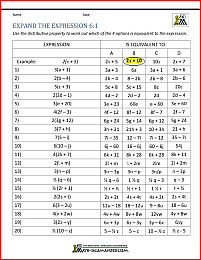
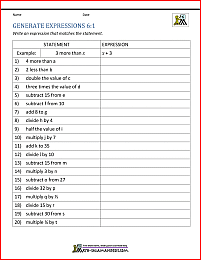
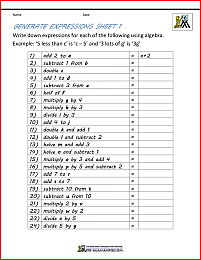
- Generate the algebra - and write your own algebraic expressions;
- Calculate the algebra - work out the value of different expressions;
- Solve the algebra - find the value of the term in the equation.
- Use the distributive property to factorize and expand different expressions
How to Print or Save these sheets 🖶
Need help with printing or saving?
Follow these 3 steps to get your worksheets printed perfectly!
How to Print or Save these sheets 🖶
Need help with printing or saving?
Follow these 3 steps to get your worksheets printed perfectly!
Subscribe to Math Salamanders News
Sign up for our newsletter to get free math support delivered to your inbox each month. Plus, get a seasonal math grab pack included for free!

Return to 5th Grade Math Worksheets
Return to 6th Grade Math Worksheets Hub
Return from How To Do Function Tables to Math Salamanders Homepage
Math-Salamanders.com
The Math Salamanders hope you enjoy using these free printable Math worksheets and all our other Math games and resources.
If you have any questions or need any information about our site, please get in touch with us using the 'Contact Us' tab at the top and bottom of every page.
