
How to do Ratio Problems
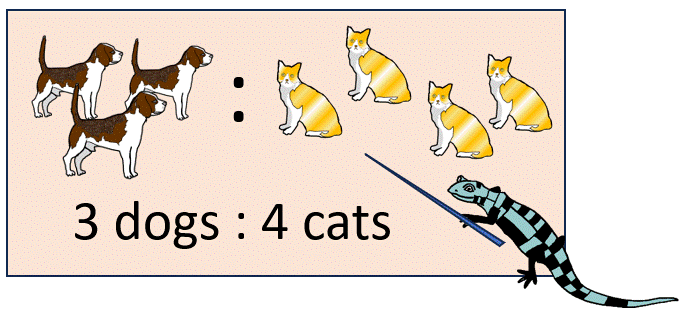
Check out our How to do Ratio Problems page to help you to get a deeper understanding of this math concept.
Our ratio support page will help you understand ratio with clear explanations of what ratio is, worked examples of solving ratio problems and types of ratio questions you might find.
There is also a quick quiz at the bottom of the page where you can practice your skill online and get immediate feedback!
How to do Ratio Problems
For all your ratio problems, we have you covered!
- What is ratio?
- Where do we find ratios in everyday life?
- How to read and understand ratios
- How to do ratio problems - simplifying ratios
- How to scale up and scale down ratios
- How to solve ratio problems step-by-step
- Different types of ratio problems
- Common mistakes with ratios
- Solving Ratio Problems Worksheets
- Ratio Problems Online Quiz
What is Ratio and why is it useful?

A ratio compares two or more quantities.
Ratios show how much of one thing there is compared to another thing.
An example might be that a ratio could show how many teachers there are compared to how many students in a school.
Ratios can be written in lots of different ways.
For example, in the image above showing 3 cars and 2 bikes, there are many different ways of writing this as a ratio:
- the ratio of cars to bikes is 3:2
- the ratio of cars to bikes is 3 to 2
- the ratio of cars to bikes is 3 for every 2
- the ratio of cars to bikes is 3/2
- the ratio shows 3 cars : 2 bikes
- there are 3 cars to 2 bikes
- there are 3 cars for every 2 bikes
- there are 3/2 cars for each bike
Ratios help us to compare two or more quantities quickly.
A ratio quickly tells us the relationship between two or more amounts.
Where to find Ratios in everyday life
Ratios are used widely in real-life in a range of different contexts.
Ratios can be used in cooking, mapping, sports, shopping, design technology and even video games.
Here are some real-life examples:
- Cooking: A lemonade recipe uses 2 cups of water for every 1 cup of lemon juice.
- Video games: In a game, you might collect 3 coins for every 1 gem, or use two sticks and 3 iron ingots for every pickaxe you want to craft.
- Art: Mixing paint might require 2 parts blue to 3 parts yellow to make the correct shade of green.
- Construction: Making a standard mortar might require 4 parts sand to 1 part cement.
- Mapping: a standard hiking map might have a scale of 1:24,000 meaning that every inch on the map is 24,000 inches on the ground.
-
Sports: there are many different ratios that can be used to analyse the performance of a sports team or individual.
For example, a sports team could be analysed on their goal ratio - the number of points/goals scored relative to the number of matched played.
How to Read and Understand Ratios
In order to understand how to do ratio problems, we need to make sure that we know exactly what the mathematical language in the problem is telling us.
Let's have a look at some example ratios and put them in a context and explain what they actually mean.
A ratio of 2:5 means that for every 2 of the first thing, there are 5 of the second thing.
Here are some examples of the ratio 2:5
- in a recipe to make muffins, you need to use 2 eggs for every 5 ounces of flour
- in a zoo if there are 2 giraffes to every 5 ostriches in an enclosure
- on a field trip there has to be a ratio of at least 2 adults for every 5 children
- to mix a light grass green paint, use 2 parts blue to 5 parts yellow
Let's look at some example ratios and explain their meaning.
Example: the ratio of hockey players to non-hockey players in a group of students is 4:7.
This means that there are 4 hockey players for every 7 non-hockey players in the group.
It does NOT mean that there are necessarily 11 students in the group.
There could be 11, 22, 33, or any multiple of 11 students in the group.
Example: the ratio of ewes to lambs in a field is 1:2.
This means that for every 1 ewe (female sheep) there are 2 lambs.
It does not necessarily mean that each ewe has had two lambs; some ewes may have had more than 2 lambs and some may have had fewer.
Example: the ratio of butter to flour to make a white sauce is 1:1.
A ratio of 1:1 indicates that there is the same quantity of each item.
This means that for every 1 unit of butter we need 1 unit of flour.
So if we use 2 tablespoons of butter, we need to use 2 tablespoons of flour.
If we use 50g of butter, then we need 50g of flour.
How to do Ratio Problems - Simplifying Ratios
Ratios can be simplified, just like fractions and in a similar way.
We can simplify ratios by looking for common factors in the ratio parts and dividing each of the parts by the common factor.
We continue until there are no more common factors in the ratio parts except 1.
Example 1) Simplify the ratio 15:45
The number 5 is a factor of both 15 and 45, so we can divide both ratio parts by 5.
15:45 → divide by 5 → 3:9
The number 3 is a factor of both 3 and 9 so we can divide both ratio parts by 3.
3:9 → divide by 3 → 1:3
1:3 cannot be simplified any further so we have finished.
Answer the ratio 15:45 simplifies to 1:3
Note: a quicker way to simplify this ratio is to notice that 15 is a factor of both numbers and divide both ratio parts by 15 giving us 1:3 straightaway.
Example 2) Simplify the ratio 12:20
The number 2 is a factor of both 12 and 20, so we can divide both numbers by 2.
12:20 → divide by 2 → 6:10
The number 2 is still a factor of both 6 and 10.
6:10 → divide by 2 → 3:5
There are no more common factors of both 3 and 5 except 1 so we have finished.
Answer the ratio 12:20 simplifies to 3:5
Note: a quicker way to simplify this ratio is to notice that 4 is a factor of both numbers and divide both ratio parts by 4 giving us 3:5 straightaway.
Example 3) Simplify the ratio 28:42
The number 2 is a factor of both 28 and 42.
28:42 → divide by 2 → 14:21
The number 7 is a factor of both 14 and 21.
14:21 → divide by 7 → 2:3
There are no more common factors of both 2 and 3 except 1 so we have finished.
Answer the ratio 28:42 simplifies to 2:3
How to Scale up and Scale down Ratios
As well as simplifying ratios, there are times when we need to scale up or scale down a ratio to solve a problem.
When we are simplifying a ratio we are usually scaling down.
When we are solving problems involving ratios we are usually scaling up.
Scaling up Ratios
When we are scaling up ratios we are multiplying all the ratio parts by the same number.
Scaling up a ratio does not change actual ratio, it just creates an equivalent ratio.
Scaling up is often used to help solve ratio problems, or working out recipes where you need to create a larger quantity than the recipe is for.
Examples:
- 1:4 → multiply by 6 → 6:24
- 3:2 → multiply by 2 → 6:4
- 5:7 → multiply by 4 → 20:28
- 4:1:3 → multiply by 10 → 40:10:30
Scaling down Ratios
When we are scaling down ratios we are dividing all the ratio parts by the same number.
Scaling down a ratio does not change actual ratio, it just creates an equivalent ratio.
Scaling down is used to simplify ratios and to solve some ratio problems.
Examples:
- 10:20 → divide by 10 → 1:2
- 16:10 → divide by 2 → 8:5
- 42:15 → divide by 3 → 14:5
- 20:32:16 → divide by 2 → 10:16:8
Scaling up is a key skill to help you understand how to do ratio problems.
How to Solve Ratio Problems Step-by-Step
Steps showing How to do Ratio Problems
- read the problem carefully and write down the ratios in the correct order
- decide whether you need to scale up or scale down the ratio to find the answer, or if you need to do something else
- use multiplication for scaling up, or division for scaling down
- answer the problem carefully in a sentence
- check that your answer seems sensible given the context
Some Example Problems
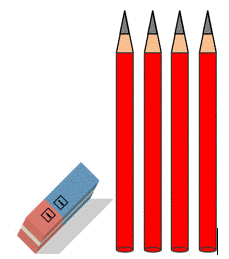
Example 1) The ratio of pencils to erasers is 4:1. If there are 12 pencils, how many erasers?
Step 1) Write down the ratio
The ratio of pencils to erasers is 4:1
We need to find the number of erasers if there are 12 pencils so we are going to scale up.
Our ratio problem looks like this: 4:1 → 12:?
We need to scale up by 3 as 4 x 3 = 12
4:1 → multiply by 3 → 4 x 3 : 1 x 3 → 12:3
This means that there are 3 erasers to 12 pencils.

Example 2) In a reptile house, the ratio of snakes to lizards is 3:7. If there are 35 lizards, how many snakes?
Step 1) Write down the ratio
The ratio of snakes to lizards is 3:7
We need to find the number of snakes if there are 35 lizards so we are going to scale up.
Our ratio problem looks like this: 3:7 → ?:35
We need to scale up by 5 as 7 x 5 = 35
3:7 → multiply by 5 → 3 x 5 : 7 x 5 → 15:35
Answer: there are 15 snakes.

Example 3) In a group of students, there are 28 swimmers and 12 non-swimmers. Write this as a ratio in its simplest form.
Step 1) Write down the ratio
The ratio of swimmers to non-swimmers is 28:12
We need to write this ratio in its simplest form.
Both 28 and 12 have a common factor of 4
We can scale down the ratio by dividing both ratio parts by 4.
28:12 → divide by 4 → 7:3
7 and 3 do not have any common factors except 1 so we have finished
Answer: the ratio of swimmers to non-swimmers is 7:3 in its simplest form.

Example 4) In a farmyard there are some chickens and some ducks. The ratio of chickens to ducks is 4:3.
If there are 42 birds in the farmyard, how many chickens and how many ducks?
Step 1) Write down the ratio
The ratio of chickens to ducks is 4:3
This time we need to find the number of chickens and the number of ducks if there are 42 birds in total.
One way we can tackle this problem is to keep scaling up the ratio until we find the correct answer
- 4:3 → 4 chickens 3 ducks = 7 birds
- 4:3 → multiply by 2 → 8:6 → 8 chickens 6 ducks = 14 birds
- 4:3 → multiply by 3 → 12:9 → 12 chickens 9 ducks = 21 birds
- 4:3 → multiply by 4 → 16:12 → 16 chickens 12 ducks = 28 birds
- 4:3 → multiply by 5 → 20:15 → 20 chickens 15 ducks = 35 birds
- 4:3 → multiply by 6 → 24:18 → 24 chickens 18 ducks = 42 birds
Answer: there are 24 chickens and 18 ducks in the farmyard.
An alternative (and quicker) way to solve this problem is to look at the ratio 4:3 which means 4 chickens for every 3 ducks giving a total of 7 birds.
There are 42 birds in the farmyard.
This means that there are 6 lots of the 7 birds which means that we need to scale up by 6.
4 chickens : 3 ducks → muliply by 6 → 24 chickens : 18 ducks
Answer: there are 24 chickens and 18 ducks in the farmyard.
Different Types of Ratio Problem
Here are some of the common types of ratio problem:
-
Part-to-Part Ratios
- Part-to-part ratios compare the number or amount of one object two another.
-
There are 10 angelfish and 14 clownfish.
What is the ratio of angelfish to clownfish? Answer 10:14.
-
Part-to-Whole Ratios (Ratio and Proportion)
- Part-to-whole ratios compare the number or amount of one object to the whole set of objects.
-
The ratio of girls to boys in a group of children is 5:8.
What fraction of the group are girls? Answer 5/13
-
Simplifying Ratios
-
There are 12 bunnies and 20 guinea pigs in an enclosure.
What is this as a ratio in its simplest form? Answer 3 bunnies : 5 guinea pigs
-
There are 12 bunnies and 20 guinea pigs in an enclosure.
-
Finding Missing Values
-
A map uses a scale of 1 cm : 5 km.
How far is 3 cm on the map? Answer 15 km
-
A map uses a scale of 1 cm : 5 km.
-
Comparing Two Ratios
-
Which is a better deal: 4 stickers for $2 or 12 stickers for $5?
Answer 12 stickers for $5
-
Which is a better deal: 4 stickers for $2 or 12 stickers for $5?
-
Ratios and Unit Rate
- The unit rate is the number or amount of one measurement compared to just one unit of another measurement.
-
Captain drives for 128 miles and uses 4 gallons of gasoline.
How many miles per gallon is this? Answer 32 miles per gallon
Common Mistakes with solving Ratio Problems
Here are some of the commonest mistakes when solving ratio problems:
-
Mixing up the order of the ratios.
- to avoid this mistake, write out the objects along with the ratio.
- e.g. if the ratio of cats to dogs is 4:3 then instead of writing 4:3, write 4 cats : 3 dogs
-
Forgetting to scale up or down both sides
- to avoid this mistake record your working out and check it once you have finished
- e.g. write 4:3 → multiply by 3 → 12:9
- Forgetting to simplify the ratio when required
-
Confusing part-to-part with part-to-whole
- part-to-part compares one object to another object
- part-to-whole compares one object to the entire (whole) set of objects
-
e.g. if there are 3 cats and 4 dogs
part-to-part: the ratio of cats to dogs is 3:4 or ¾
part-to-whole: the fraction (or proportion) of animals which are cats is 3/7
part-to-whole: the fraction (or proportion) of animals which are dogs is 4/7
How to do Ratio Problems - Summary

We use ratios to compare two or more amounts.
We scale up ratios by multiplying all the ratio parts by the same number.
We scale down ratios by dividing all the ratio parts by the same number.
Scaling up and down ratios can help us to solve ratio problems.
We can simplify ratios.
Ratios can be found just about everywhere.
Ratio & Unit Rate Worksheets
These sheets are a great way to introduce ratio of one object to another using visual aids.
The sheets in this section are at a more basic level than those on this page.
We also have some ratio and proportion worksheets to help learn these interrelated concepts.


Ratio Word Problems Online Quiz
The link below will open the quiz in a dedicated quiz page or you can preview a copy of the quiz underneath.
Our quizzes have been created using Google Forms.
At the end of the quiz, you will get the chance to see your results by clicking 'See Score'.
This will take you to a new webpage where your results will be shown. You can print a copy of your results from this page, either as a pdf or as a paper copy.
For incorrect responses, we have added some helpful learning points to explain which answer was correct and why.
We do not collect any personal data from our quizzes, except in the 'First Name' and 'Group/Class' fields which are both optional and only used for teachers to identify students within their educational setting.
We also collect the results from the quizzes which we use to help us to develop our resources and give us insight into future resources to create.
For more information on the information we collect, please take a look at our Privacy Policy
We would be grateful for any feedback on our quizzes, please let us know using our Contact Us link, or use the Facebook Comments form at the bottom of the page.
Ratio Word Problems Online Quiz
This quick quiz tests your knowledge and skill at solving word problems involving ratios.
How to Print or Save these sheets 🖶
Need help with printing or saving?
Follow these 3 steps to get your worksheets printed perfectly!
How to Print or Save these sheets 🖶
Need help with printing or saving?
Follow these 3 steps to get your worksheets printed perfectly!
Subscribe to Math Salamanders News
Sign up for our newsletter to get free math support delivered to your inbox each month. Plus, get a seasonal math grab pack included for free!

Return to 6th Grade Math Worksheets
Return from How to do Ratio Problems to Math Salamanders Homepage
Math-Salamanders.com
The Math Salamanders hope you enjoy using these free printable Math worksheets and all our other Math games and resources.
If you have any questions or need any information about our site, please get in touch with us using the 'Contact Us' tab at the top and bottom of every page.
