- Home |
- About |
- Contact Us |
- Privacy |
- Newsletter |
- Shop |
- Donate
Understanding Negative Numbers
On a Number Line
Our Understanding Negative Numbers on a Number Line page will help develop your confidence and understanding of negative numbers.
We have a range of worked examples, support and explain the relevance of this concept here!
There is also a quick quiz at the bottom of the page where you can test your skill online and get immediate feedback!
Quicklinks to ...
- What is a Negative Number?
- Negative Numbers on a Number Line
- Negative Numbers in Real Life
- How to Compare Negative Numbers
- Adding and Subtracting with Negative Numbers
- Negative Numbers - key facts
- Common Mistakes with Negative Numbers
- Negative Number Line Worksheets
- More related resources
- Negative Number Line Online Practice Quiz
Understanding Negative Numbers on a Number Line
What is a Negative Number?
A negative number is a number which is less than 0.
Negative numbers are written with a minus sign (-) in front of them to show they are negative.
- positive numbers are always more than zero;
- negative numbers are always less than zero.
Any type of number - fractions, decimals, integers can be negative.
We use negative numbers to show different amounts which are less than zero, for example in temperature.
You have probably seen quite a few negative numbers before without realising it!
Examples of negative numbers
- -3
- -27
- -1½
- -13.5
- -8°F
- -$127
Negative Numbers on a Number Line
A number line is a straight line with numbers placed in order from smallest to largest.
When we look at a negative number line, we usually have 0 in the middle of the line.
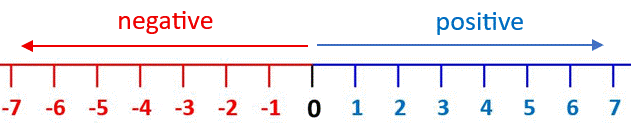
All the numbers to the left of zero are negative numbers.
All the numbers to the right of zero are positive numbers.
You will notice that -1 and 1 are both the same distance away from 0 on the number line - they are both 1 step away.
-2 and 2 are both 2 steps away from 0.
-3 and 3 are both 3 steps away from 0
and so on...
We can also think about this in another way:
- -1 is one step below 0; 1 is one step above zero
- -2 is two steps below 0; 2 is two steps above zero
- -3 is three steps below 0; 3 is three steps above zero
- and so on...
How to Compare Negative Numbers
Using a number line is a great way to compare negative numbers.
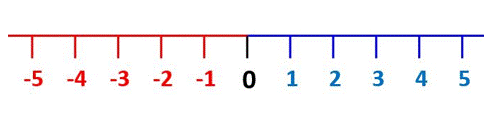
The numbers on the left hand side of the line are the smallest and have the lowest values.
As you move along the number line to the right, the numbers get larger and have the highest values.
In other words:
- as you go left the numbers get smaller;
- as you go right the numbers get bigger.
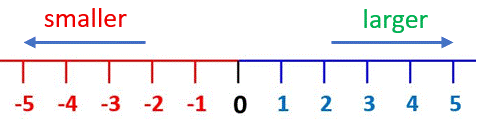
This means that...
- -1 is greater than -3
- 2 is greater than -4
- -5 is less than -2
- -4 is less than 1
- any negative number is less than zero
- any negative numbers is always less than any positive number
This often confuses students who think that because 3 is larger than 1 then -3 must be larger than -1. However this is not true.
We can see this more clearly in the context of temperature:
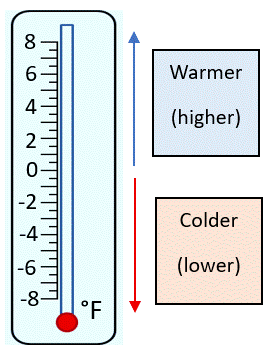
- -6°F is colder (or has a lower temperature) than -2°F
- -4°F is warmer (or has a higher temperature) than -8°F
- 0°F is warmer than both -4°F and -8°F
- so as the temperature becomes more negative, it is getting colder and has a lower value.
- as the temperature becomes more positive, it is getting warmer and has a higher value.
Adding and Subtracting Negative Numbers
Let's use a number line to look at simple adding and subtracting with negative numbers.
The important thing to remember is that when we are adding a positive number we are going to move right along the number line.
When we are subtracting a positive number, we are going left along the number line.
1) Work out -3 + 5.
Our first step is to find -3 on the number line and mark it out as our starting point.
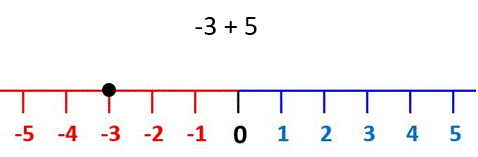
Secondly we need to jump 5 places to the right as we are adding a positive number.
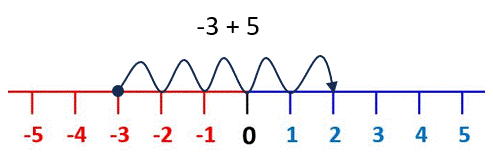
We end up at number 2.
Answer: -3 + 5 = 2
2) Work out 4 − 6.
Our first step is to find 4 on the number line and mark it out as our starting point.
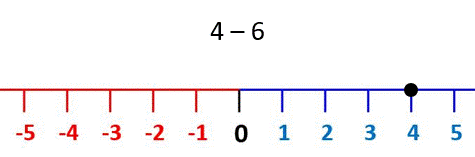
Secondly we need to jump 6 places to the left as we are subtracting a positive number.
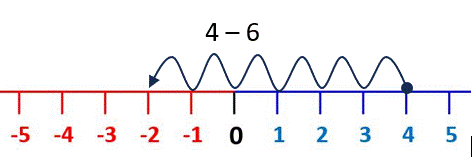
We end up at number -2.
Answer: 4 − 6 = -2
3) Work out -1 − 4.
Our first step is to find -1 on the number line and mark it out as our starting point.
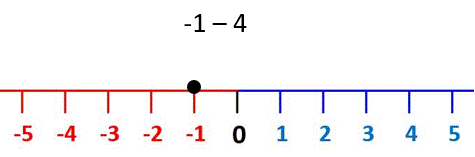
Secondly we need to jump 4 places to the left as we are subtracting a positive number.
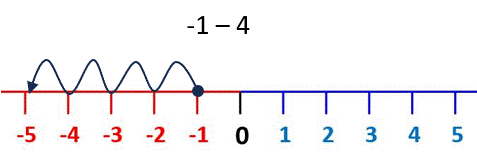
We end up at number -5.
Answer: -1 − 4 = -5
Negative Numbers in Real Life
We use negative numbers in a range of different contexts in real life.
This means that in context such as money, measurements and time we might see absolute value being used.
Here are some contexts where we might use absolute value:
- Temperature
- If the temperature is 2°F and it gets colder by –7 degrees then it will be -5°F.
- Elevation
- If we are measuring height at sea level a diver who is 50 meters underwater will be at a height of -50 m.
- Money
- If you have $100 in your bank account and you spend $300 then your bank balance is $100 − $300 = -$200.
- Time
- If there is 10 minutes until the launch of a rocket, we might say that launch time is at "T minus ten minutes".
- Sports
- If a soccer team has scored 15 goals but let in 22 goals then we can say that their goal difference is 15 − 22 = -7.
- If par for a golf course is 72 and a golfer takes 68 shots to complete the course then their score is 68 − 72 = -4 (or 4 below par)
Common Mistakes with Negative Numbers
Here are a few of the commonest mistakes when students are learning about negative numbers:
1) Getting confused when comparing negative numbers
Remember - the more negative a number is, the lower the value!
- -3 > -1 INCORRECT
- -3 < -1 CORRECT
2) When subtracting, if the minuend is smaller than the subtrahend, then the result will be negative .
Parts of a subtraction equation:
minuend − subtrahend = difference
- 9 − 7 = 2 but 7 − 9 = -2
- 6 − 2 = 4 but 2 − 6 = -4
- 12 − 9 = 3 but 9 − 12 = -3
3) When you increase the value of a negative number, it becomes less negative and might become positive.
- Increase -7 by 2 gives -5
- Increase -2 by 6 gives 4
- Increase -10 by 3 gives -7
Negative Numbers - Key Facts
- Negative numbers are numbers which are less than zero.
- Zero is neither positive or negative.
- Negative numbers are always to the left of zero on a number line.
- The further left you go on a number line, the smaller the number.
- You can use a number line to help you add and subtract with negative numbers.
Understanding Negative Numbers on a Number Line Worksheets
These worksheets will help you to understand and practice placing negative numbers on a number line.
Number to place include positive and negative numbers including decimal values.

More Recommended Math Worksheets
Take a look at some more of our worksheets similar to these.
What are Negative Numbers Explorer
This is a Integer Number Explorer app created by:
PhET Interactive Simulations University of Colorado Boulder https://phet.colorado.edu
It is a great app for exploring negative numbers and especially for comparing positive and negative numbers.
You can either choose 'Explorer' Mode for a real-life example of negative numbers relating to height above sea level, or you can go to 'Generic' Mode which involves comparing and sequencing positive and negative numbers on a number line.
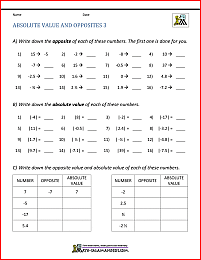
Absolute Value Support and Worksheets
Negative Number Lines Quiz
This quick quiz tests your understanding and skill at positioning and reading numbers on number lines from -10 to 10.
How to Print or Save these sheets 🖶
Need help with printing or saving?
Follow these 3 steps to get your worksheets printed perfectly!
How to Print or Save these sheets 🖶
Need help with printing or saving?
Follow these 3 steps to get your worksheets printed perfectly!
Subscribe to Math Salamanders News
Sign up for our newsletter to get free math support delivered to your inbox each month. Plus, get a seasonal math grab pack included for free!

Return to 6th Grade Math Worksheets
Return from Understanding Negative Numbers on a Number Line to Math Salamanders Homepage
Math-Salamanders.com
The Math Salamanders hope you enjoy using these free printable Math worksheets and all our other Math games and resources.
If you have any questions or need any information about our site, please get in touch with us using the 'Contact Us' tab at the top and bottom of every page.
