- Home |
- About |
- Contact Us |
- Privacy |
- Newsletter |
- Shop |
- Donate
Comparing Numbers in Scientific Notation
Support Page

Welcome to our Comparing Numbers in Scientific Notation support page.
This page will show you how to compare numbers written in scientific notation.
As well as step-by-step instructions, there are also worked examples and practice worksheets.
Before you tackle scientific notation, you should be confident multiplying and dividing by 10 and 100.
Quicklinks to...
- Parts of a Scientific Notation Expression
- What is Scientific Notation?
- How to Compare 2 Numbers in scientific notation
- Comparing Numbers in Scientific Notation Worked Examples
- Comparing Numbers in Scientific Notation Worksheets
- Comparing Numbers in Scientific Notation Quiz
- More Recommended Resources
Parts of a Scientific Notation Expression

- m is the coefficient which has an absolute value of at least 1 and less than 10. So 1 ≤ |m| < 10
- n is the exponent and is an integer, which can be positive, negative or zero
- 10 is the base
What is Scientific Notation?
Scientific notation is a special way of writing numbers.
Scientific notation is also called standard index form, or standard form in the UK.
Numbers in scientific notation are written in the form:
m x 10n
- where m is a number which has an absolute value greater than or equal to 1 and less than 10.
- where n is an integer which can be positive or negative or zero.
These numbers are written in scientific notation:
- 2.7 x 10⁴
- -8.2 x 10⁻²
- 5.1274 x 100
- 9 x 10¹⁵
- -8.7 x 10⁻⁸
These numbers are not written in scientific notation:
- 273 x 107 - the coefficient is greater than 10 (it is 273).
- 0.7 x 10³ - the coefficient is less than 1 (it is 0.7)
- 8 x 29 - the base needs to be 10, not 2
- 7.328 x 1000 - the base needs to be 10 and needs to have an exponent
- -0.3 x 10⁻² - the coefficient is less than 1 (it is 0.3)
Comparing Numbers in Scientific Notation
We will split this up into 4 different scenarios:
- comparing two positive numbers written in scientific notation
- comparing two negative numbers written in scientific notation
- comparing a negative number and a positive number written in scientific notation
- comparing a number in scientific notation with a number in standard notation
1. Comparing 2 positive numbers written in scientific notation
When we compare two positive numbers written in scientific notation, we only need to look at one thing: the exponent

The number with the biggest exponent is the bigger number.
This is true whether the exponent is positive or negative.
- so if b > d, then a x 10b > c x 10d
- if b < d then a x 10b < c x 10d
What if both numbers have the same exponent?
If both numbers have the same exponent (or if b = d) then the number with the biggest coefficient is the bigger number.
Examples
- 1.48 x 10³ is smaller than 4.82 x 10⁵ because the first number has an exponent of 3 and second number has a bigger exponent of 5.
- 3.02 x 10¹² is bigger than 9.1 x 10⁸ because the first number has an exponent of 12 and the second number has a smaller exponent of 8
- 5.2 x 10⁻² is bigger than 1.78 x 10⁻⁴ because when you compare the exponents, -2 > -4
- 8.45 x 10⁻² is smaller than 2.8 x 100 because when you compare the exponents, -2 < 0
- 3.2 x 10⁵ is bigger than 2.9 x 10⁵ because both numbers have the same exponents and 3.2 > 2.9
2. Comparing 2 negative numbers written in scientific notation
If we are comparing two negative numbers, then the number which is the least negative (closest to zero) is the bigger number.
So, as an example, -2 is greater than -5 because -2 is closer to 0 than -5.
When we compare two negative numbers written in scientific notation, we only need to look at one thig the exponent
The number with the smaller exponent is the bigger number as it is the least negative.
This is true whether or not the exponent is positive or negative.
What if both negative numbers have the same exponent?
If both numbers have the same exponent, then the negative number with the smaller coefficient is the bigger number.
Examples
- -1.48 x 10³ is bigger than -4.82 x 10⁵ because the first number has a smaller exponent of 3 and second number has an exponent of 5.
- -3.02 x 10¹² is smaller than -9.1 x 10⁸ because the first number has an exponent of 12 and the second number has a smaller exponent of 8
- -5.2 x 10⁻² is smaller than -1.78 x 10⁻⁴ because when you compare the exponents, -2 > -4
- -8.45 x 10⁻² is bigger than -2.8 x 100 because when you compare the exponents, -2 < 0
- -3.2 x 10⁵ is smaller than -2.9 x 10⁵ because both numbers have the same exponents and -3.2 < -2.9
3. Comparing a negative numbers with a positive number in scientific notation
If we are comparing any negative numbers with any positive number, then the positive number is always bigger.
So any positive number written in scientific notation is always bigger than any negative number written in scientific notation.
Examples
- -2.6 x 10³ is smaller than 1.2 x 10² because a positive number is always greater than a negative number
- 5.8 x 10⁻⁴ is bigger than -7 x 10⁵ because a positive number is always greater than a negative number
- -2.6 x 10⁻² is smaller than 1.4 x 10⁻⁸ because a positive number is always greater than a negative number
4. Comparing a number in scientific notation to a number in standard notation
When you are comparing numbers in scientific notation to numbers in standard notation, you have 2 choices:
- convert the number in scientific notation into standard notation, or
- convert the number in standard notation to scientific notation
It does not really matter which one of these options you choose.
The only thing I would say is that if you are comparing numbers that are very big (more than 7 or 8 digits) or numbers that are very small, then using scientific notation is much easier than trying to count the digits of numbers written in standard notation to see which number is bigger.
Examples
- 3.4 x 10³ is bigger than 3,000 because 3.4 x 103 = 3.4 x 1000 = 3,400.
- 5.8 x 10⁻² is smaller than 0.06 because 5.8 x 10-2 = 5.8 ÷ 100 = 0.058.
- 2.6 x 10⁹ is bigger than 300,000,000 because 300,000,000 = 3 x 10⁸ which has a smaller exponent than the first number.
Comparing Numbers in Scientfic Notation Worked Examples
Example 1) Which of these numbers is bigger:
4.8 x 10⁵ or 8.2 x 10³.
Both these numbers are positive so we are comparing two positive numbers in scientific notation.
- 4.8 x 10⁵ the exponent is 5
- 82. x 103 the exponent is 3.
So our final answer is 4.8 x 10⁵ > 8.2 x 10³
Example 2) Put these 3 numbers in order from smallest to largest:
3.4 x 10⁻¹, 1.7 x 101 and 7.8 x 10⁻².
All of these numbers are positive, so we just need to order the exponents.
- 3.4 x 10⁻¹ the exponent is -1
- 1.7. x 101 the exponent is 1.
- 7.8 x 10⁻² the exponent is -2.
The correct order for the exponents from smallest to largest is: -2, -1, 1
So the correct order from smallest to largest is:
7.8 x 10⁻², 3.4 x 10⁻¹ and 1.7 x 101
Example 3) Put these 3 numbers in order from smallest to largest:
-9.3 x 10⁻¹, -3.1 x 10⁶ and -2.5 x 10³.
All of these numbers are negative, so we need to order the exponents.
- -9.3 x 10⁻¹ the exponent is -1.
- -3.1 x 10⁶ the exponent is 6
- -2.5 x 10³ the exponent is 3.
The correct order for the exponents from smallest to largest is: -1, 3, 6
With negative numbers, the smaller the absolute value, the bigger the number, so the numbers with the smallest exponent is the largest.
So the correct order from smallest to largest is:
-3.1 x 10⁶, -2.5 x 10³ and , -9.3 x 10⁻¹
Example 4) Put these 3 numbers in order from smallest to largest:
2.8 x 10⁻², -4 x 10⁻³ and -6.5 x 10⁻¹.
Two of these numbers are negative and one of the numbers is positive - the positive number will be the largest.
Let us order the two negative numbers
- -4 x 10⁻³ the exponent is -3
- -6.5 x 10⁻¹ the exponent is -1.
With negative numbers, the smaller the absolute value, the bigger the number, so the numbers with the smallest exponent is the largest.
This means that -4 x 10⁻³ is greater than -6.5 x 10⁻¹
So the correct order from smallest to largest is:
-6.5 x 10⁻¹, -4 x 10⁻³ and 2.8 x 10⁻²
Comparing Numbers in Scientific Notation Worksheets
We have divided our worksheets for comparing numbers into 3 sections:
Comparing 2 Numbers in Scientific Notation Worksheets
We have created 3 worksheets for you to practice this skill.
All the worksheets involve comparing two numbers in scientific notation and also comparing numbers in scientific notation to numbers in standard notation.
Worksheet 1 involves comparing positive numbers in scientific notation with positive exponents only.
Worksheet 2 involves comparing positive numbers in scientific notation with both positive and negative exponents.
Worksheet 3 is the most challenging and involves comparing both positive and negative numbers with positive and negative exponents.


Ordering Numbers in Scientific Notation Worksheets
We have created 3 worksheets for you to practice this skill.
All the worksheets involve ordering up to 5 numbers which are all in scientific notation.
Worksheet 1A involves ordering positive numbers in scientific notation with positive exponents only.
Worksheet 2A involves ordering positive numbers in scientific notation with both positive and negative exponents.
Worksheet 3A is the most challenging and involves ordering both positive and negative numbers with positive and negative exponents.


Ordering Numbers in Scientific Notation and Standard Notation Worksheets
We have created 3 worksheets for you to practice this skill.
All the worksheets involve ordering up to 5 numbers in both scientific and standard notation.
Worksheet 1B involves ordering positive numbers in both standard and scientific notation with positive exponents only.
Worksheet 2B involves ordering positive numbers in both standard and scientific notation with both positive and negative exponents.
Worksheet 3B is the most challenging and involves ordering both positive and negative numbers in standard and scientific notation with positive and negative exponents.


More Recommended Math Resources
Take a look at some more of our resources similar to our mm to inches conversion calculator.
Standard Notation and Scientific Notation Support Pages
We also have a pages dedicated to converting numbers between standard notation and scientific notation.
There are step-by-step instructions and lots of worked examples to look at.
There are also practice worksheets to try out.

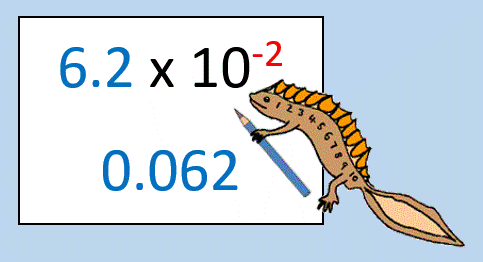
Convert Scientific to Standard Notation Calculators
These calculators will take numbers in scientific or standard notation and convert between the two different notations.
It can take numbers with exponents between -30 and 30.

More Number System Converters
Our number system converters will convert numbers from binary, octal or hexadecimal into decimal (or from decimal to binary, octal or hex).
The calculators also show you detailed working out so you can see how to do it yourself!
Comparing Numbers in Scientific Notation Online Quiz
The link below will open the quiz in a dedicated quiz page or you can preview a copy of the quiz underneath.
Our quizzes have been created using Google Forms.
At the end of the quiz, you will get the chance to see your results by clicking 'See Score'.
This will take you to a new webpage where your results will be shown. You can print a copy of your results from this page, either as a pdf or as a paper copy.
For incorrect responses, we have added some helpful learning points to explain which answer was correct and why.
We do not collect any personal data from our quizzes, except in the 'First Name' and 'Group/Class' fields which are both optional and only used for teachers to identify students within their educational setting.
We also collect the results from the quizzes which we use to help us to develop our resources and give us insight into future resources to create.
For more information on the information we collect, please take a look at our Privacy Policy
We would be grateful for any feedback on our quizzes, please let us know using our Contact Us link, or use the Facebook Comments form at the bottom of the page.
Comparing Numbers in Scientific Notation Online Quiz
This quick quiz tests your skill at comparing a range of numbers in scientific notation.
How to Print or Save these sheets 🖶
Need help with printing or saving?
Follow these 3 steps to get your worksheets printed perfectly!
How to Print or Save these sheets 🖶
Need help with printing or saving?
Follow these 3 steps to get your worksheets printed perfectly!
Subscribe to Math Salamanders News
Sign up for our newsletter to get free math support delivered to your inbox each month. Plus, get a seasonal math grab pack included for free!

Math-Salamanders.com
The Math Salamanders hope you enjoy using these free printable Math worksheets and all our other Math games and resources.
If you have any questions or need any information about our site, please get in touch with us using the 'Contact Us' tab at the top and bottom of every page.
