- Home |
- About |
- Contact Us |
- Privacy |
- Newsletter |
- Shop |
- Donate
Fractions Decimals Percents
Support Page
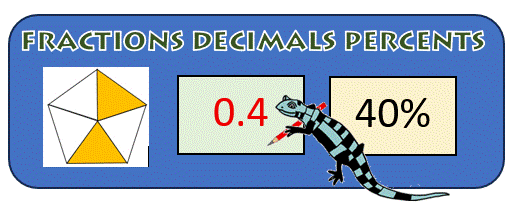
Welcome to our Fractions Decimals Percents support page.
Use this page to find support converting between fractions, decimals and percentages with conversion tables, examples, worksheets and our new calculator.
What is a fraction?
A fraction is a number which contains parts of a whole.
In the example below, the fraction shaded is 2/5 because 2 parts out of 5 are shaded.
The parts have to be equal in size!

\[ {2 \over 5} \; is \; shaded \; ; {3 \over 5} \; is \; unshaded. \]
What is a decimal?
A decimal is a number which consists of a whole number and part of a whole.
All decimal numbers (decimals) have a decimal point.

In the example above, the decimal shown is 26.417
This number has:
- 2 tens
- 6 ones
- 4 tenths
- 1 hundredth
- 7 thousandths
What is a percentage?
Percent means out of 100.
A percentage is a way of expressing a number as a number of parts out of 100.
1% means 1 out of 100 or 0.01
10% means 10 out of 100 which is the same as one-tenth or 0.1
50% means 50 out of 100 which is the same as one-half or 0.5
100% means 100 out of 100 which is the same as one whole or 1
150% means 150 out of 100 which is the same as 1 1/2 or 1.5
200% means 200 out of 100 which is the same as two wholes or 2
Fraction Decimal Percent Calculator
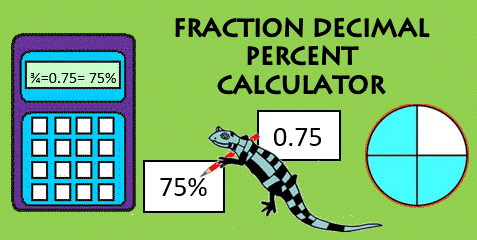
Try our new fraction decimal percent calculator to help you convert between the three number types.
The best feature about our calculator is that it shows the all the working out step-by-step.
Fractions Decimals Percents Conversion Table
Below are some common conversions for fractions into decimals and percents.
| Fraction | Equivalent to | Decimal | Percent |
|
1/2 2/2 1/3 2/3 3/3 1/4 2/4 3/4 4/4 1/5 2/5 3/5 4/5 5/5 1/6 2/6 3/6 4/6 5/6 6/6 1/8 2/8 3/8 4/8 5/8 6/8 7/8 8/8 1/10 2/10 3/10 4/10 5/10 6/10 7/10 8/10 9/10 10/10 |
1/2 1 1/3 2/3 1 1/4 1/2 3/4 1 1/5 2/5 3/5 4/5 5/5 1/6 1/3 1/2 2/3 5/6 1 1/8 1/4 3/8 1/2 5/8 3/4 7/8 1 1/10 1/5 3/10 2/5 1/2 3/5 7/10 4/5 9/10 1 |
0.5 1.0 0.333 0.667 1.0 0.25 0.5 0.75 1.0 0.2 0.4 0.6 0.8 1.0 0.167 0.333 0.5 0.666 0.833 1.0 0.125 0.25 0.375 0.5 0.625 0.75 0.875 1.0 0.1 0.2 0.3 0.4 0.5 0.6 0.7 0.8 0.9 1.0 |
50% 100% 33.3% 66.7% 100% 25% 50% 75% 100% 20% 40% 60% 80% 100% 16.7% 33.3% 50% 66.7% 83.3% 100% 12.5% 25% 37.5% 50% 62.5% 75% 87.5% 100% 10% 20% 30% 40% 50% 60% 70% 80% 90% 100% |
Where a digit is underlined, it means that the number has been rounded to 3 decimal places, or to the nearest 0.1%.
Fractions Decimals Percents Conversion Triangle
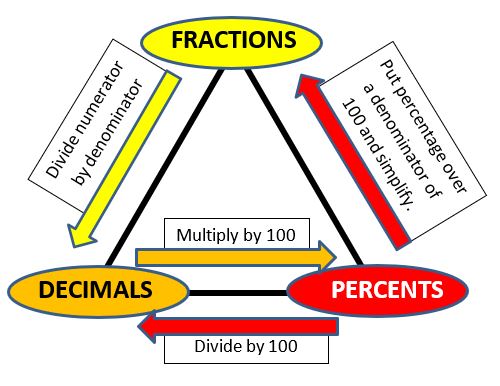
This triangle shows how fractions, decimals and percents are related to each other.
Steps to Converting Fractions to Decimals and Percentages
Convert a Fraction to a Decimals
- To convert a fraction to a decimal, simply divide the numerator by the denominator.
Example: Convert 3/8 into a decimal.
To convert a fraction into a decimal we divide the numerator by the denominator.
\[ 3 \div 8 = 0.375 \]
Convert a Fraction to a Percentage
To convert a fraction into a percentage, follow the two steps below.
- Step 1) Convert the fraction into a decimal (see above)
- Step 2) Multiply the decimal by 100 to turn it into a percentage.
Example: convert 7/20 into a percentage.
Step 1) We convert the fraction into a decimal by dividing the numerator by the denominator.
\[ {7 \over 20} = 7 \div 20 = 0.35 \]
Step 2) We multiply the decimal by 100 to turn it into a percentage.
\[ 0.35 \times 100 = 35\% \]
Steps to Converting Decimals to Percentages and Fractions
Convert a Decimal to a Percentage
- To convert a Decimal into a Percentage simply multiply the decimal by 100
Example: convert 0.352 into a percentage.
To convert a decimal into a percentage we multiply the decimal by 100.
\[ 0.352 \times 100 = 35.2\% \]
Convert a Decimal to a Fraction
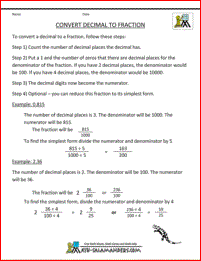
To convert a decimal to a fraction, you need to follow the 3 steps below:
- Step 1) Put the decimal over a denominator of 1 to make it into a fraction (the value of the decimal stays the same).
- Step 2) Multiply the numerator and denominator of the fraction you have just made by 10n where n is the number of decimal places the number has.
- You should now have a decimal fraction where both the numerator and denominator have whole number values.
- Step 3) Optional - you can reduce this fraction to its simplest form.
Example: convert 0.48 into a fraction.
Step 1) Put the decimal over a denominator of 1.
\[ 0.48 = {0.48 \over 1} \]
Step 2) Multiply the numerator and denominator of the fraction you have just made by 102 = 100, since the number has 2 decimal places.
This gives us a decimal fraction which has the same value as the original decimal.
\[ {0.48 \over 1} = {0.48 \over 1} \times {100 \over 100} = {0.48 \times 100 \over 1 \times 100} = {48 \over 100 } \]
Step 3) Reduce this fraction to its simplest form.
The highest common factor of 48 and 100 is 4, so we can divide the numerator and denominator by 4 to reduce the fraction to simplest form.
So we have: \[ {48 \over 100 } = {48 \div 4 \over 100 \div 4 } = {12 \over 25} \]
This means that: \[ 0.48 = {12 \over 25} \]
Steps to Converting Percentages to Decimals and Fractions
Convert a Percentage to a Decimal
- To convert a Percentage into a Decimal simply divide the percentage by 100
Example: convert 18% into a decimal.
To convert a percentage into a decimal we divide the percentage by 100.
\[ 18\% = 18 \div 100 = 0.18 \]
Convert a Percentage to a Fraction
- Step 1) Put the percentage over a denominator of 100.
- Step 2) (Optional) You may need to simplify the fraction.
Example: convert 65% into a fraction in its simplest form.
Step 1) Put the percentage over a denominator of 100
\[ 65\% = {65 \over 100} \]
Step 2) Simplify the fraction.
The highest common factor of 65 and 100 is 5 so we can divide the numerator and denominator by 5.
\[ {65 \over 100} = { 65 \div 5 \over 100 \div 5} = {13 \over 20 } \]
This gives us: \[ 65\% = {13 \over 20 } \]

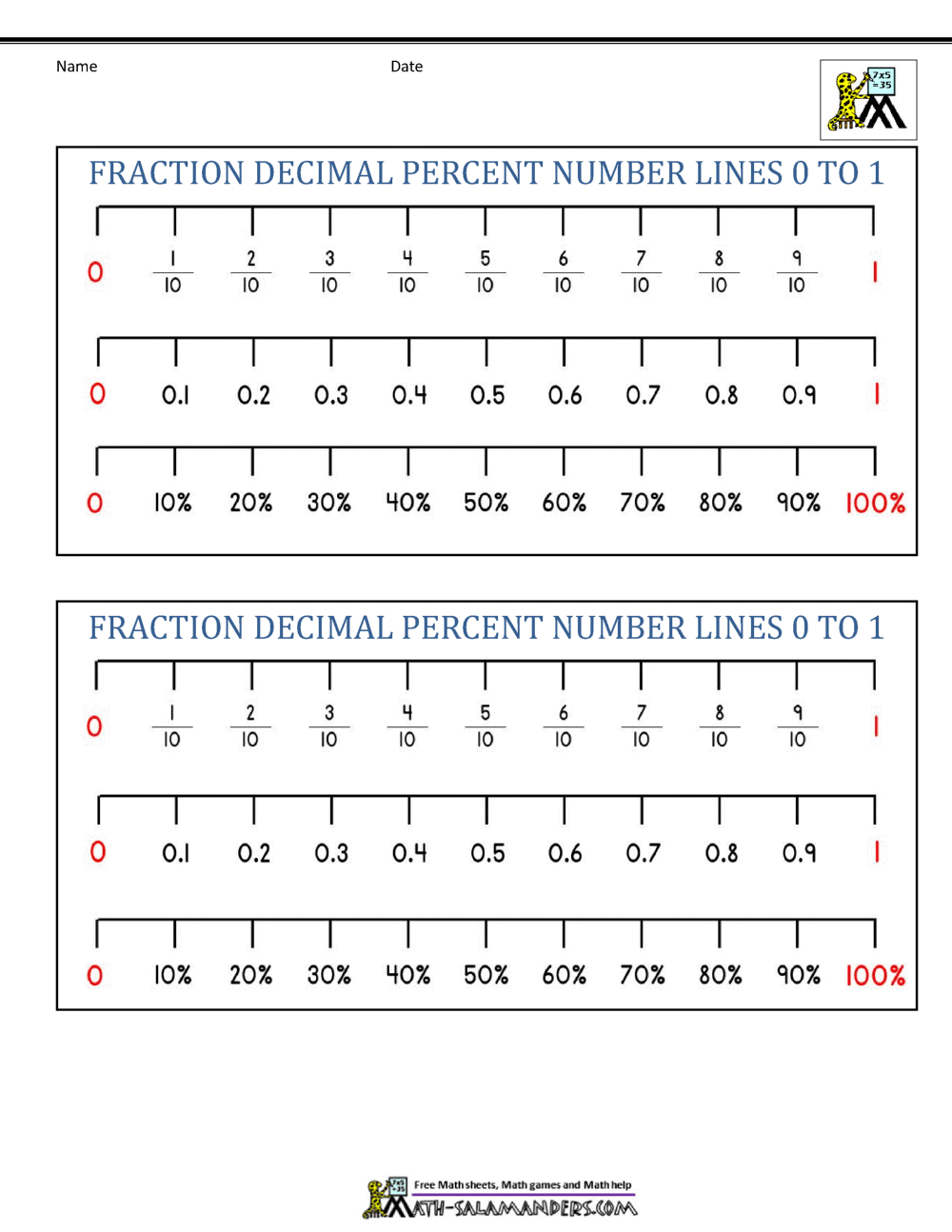
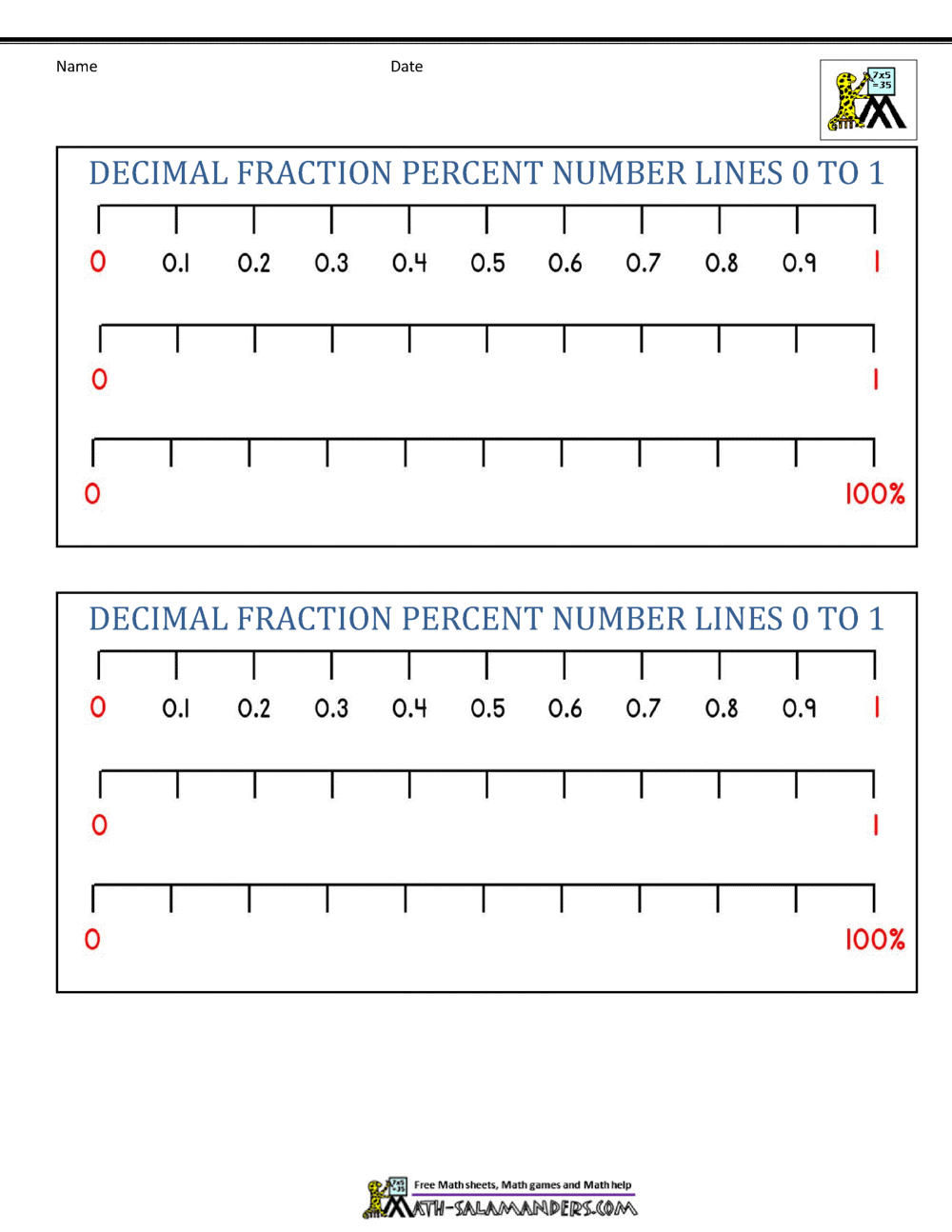
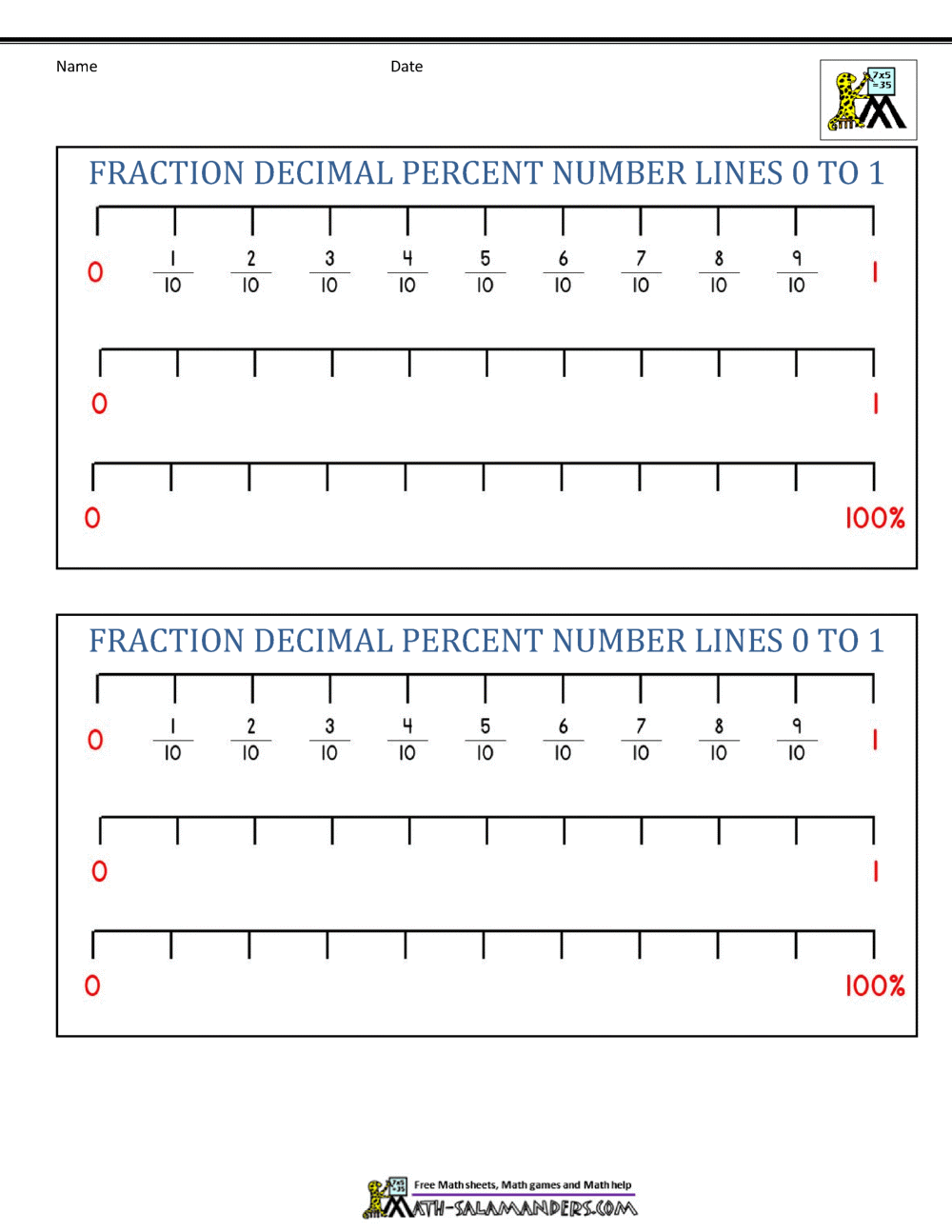
Fractions Decimals Percents Equivalence Printables
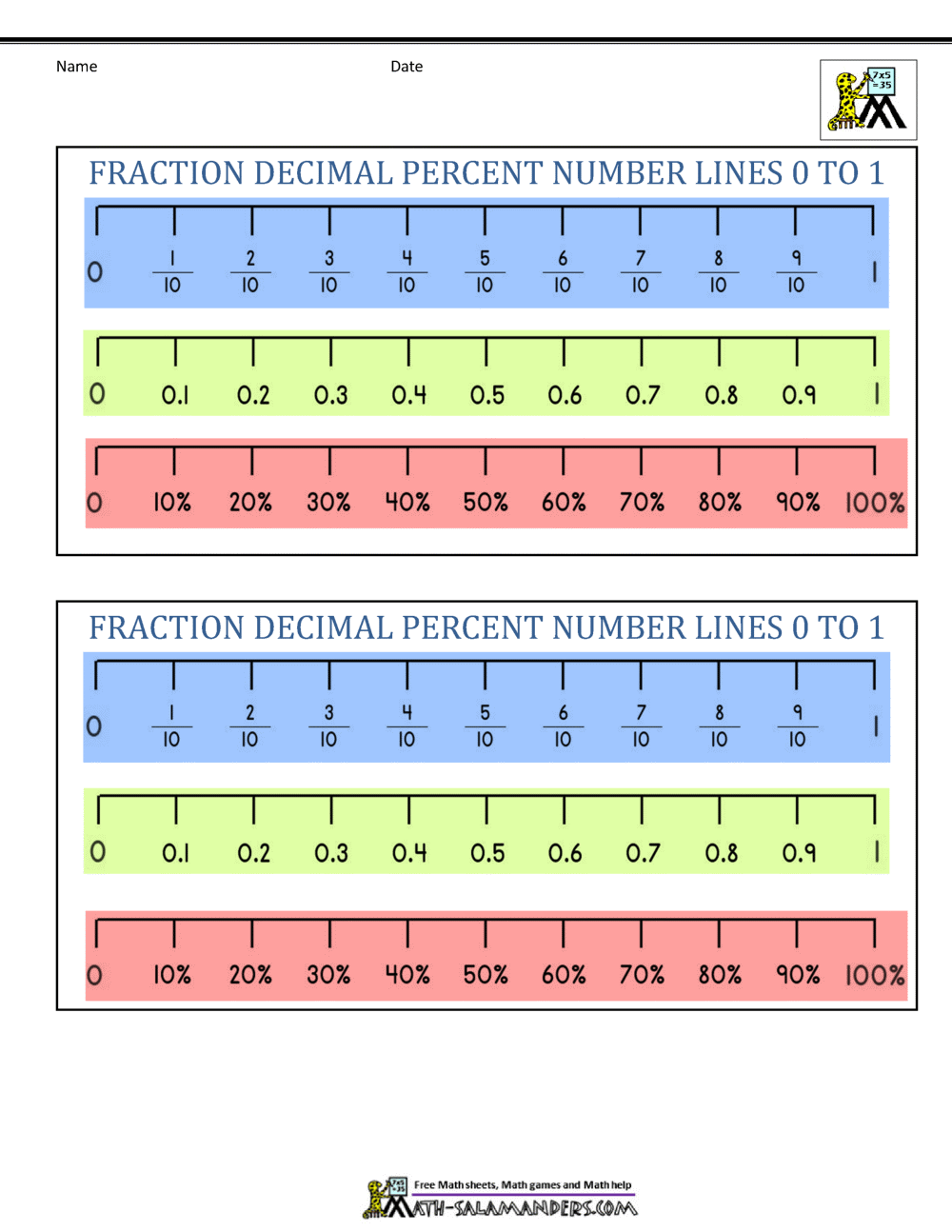
These printables are a great visual way to see how common fractions, decimals and percents are equivalent.
There are also some worksheets with some of the facts missing.

More Recommended Math Worksheets
Take a look at some more of our worksheets similar to these.
Fractions Decimals Percents Worksheets
Looking to convert between fractions, decimals and percentages?
We have a wide range of worksheets to meet your needs!
Converting Fractions to Decimals
Here you will find some simple information and advice about how to convert a fraction to a decimal.
You will also find a printable resource sheet which explains about how to convert fractions to decimals in a little more detail.
Converting Decimals to Fractions
Here you will find some simple information and advice about how to convert a decimal to a fraction. Before you learn how to do this, you should also know about simplifying fractions.
You will also find a printable resource sheet and some practice sheets which will help you understand and practice this math skill.
Converting Percentages to Fractions
Here you will find some simple information and advice about how to convert a percentage to a fraction.
You will also find a printable resource sheet and some practice sheets which will help you understand and practice this math skill.
How to Print or Save these sheets 🖶
Need help with printing or saving?
Follow these 3 steps to get your worksheets printed perfectly!
How to Print or Save these sheets 🖶
Need help with printing or saving?
Follow these 3 steps to get your worksheets printed perfectly!
Subscribe to Math Salamanders News
Sign up for our newsletter to get free math support delivered to your inbox each month. Plus, get a seasonal math grab pack included for free!

Return to Learning Fractions Hub page
Return from Fractions Decimals Percents page to Math Salamanders Homepage
Math-Salamanders.com
The Math Salamanders hope you enjoy using these free printable Math worksheets and all our other Math games and resources.
If you have any questions or need any information about our site, please get in touch with us using the 'Contact Us' tab at the top and bottom of every page.
