- Home |
- About |
- Contact Us |
- Privacy |
- Newsletter |
- Shop |
- Donate
Linear Equations that are Parallel
Support Page
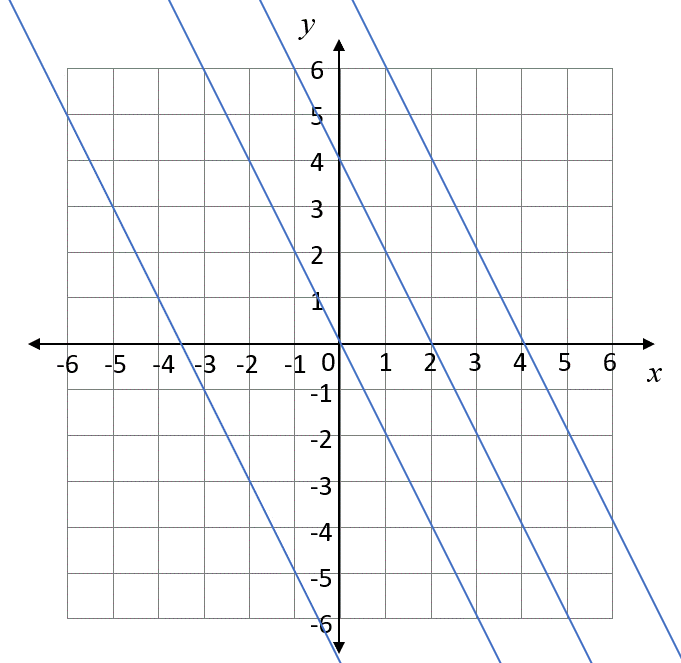
Welcome to our Linear Equations that are Parallel Support Page.
Looking for some help and support for finding linear equations which are parallel or find missing points in parallel lines?
Check out this page with clear explanation, worked examples and some practice worksheets!
We also have a linear equation calculator which you can use to solve linear equations with two points step-by-step!
Linear Equations that are Parallel Support
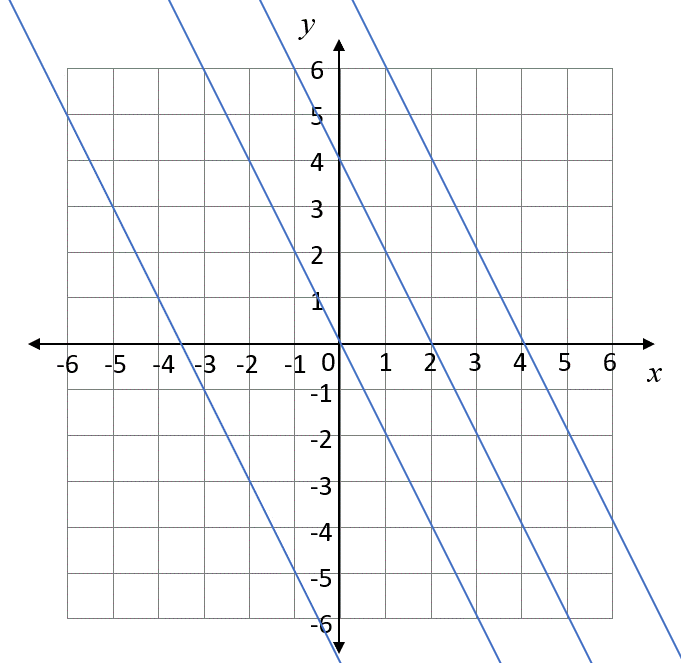
This page contains all the information you need to find a set of parallel lines from any given line.
Find out a quick way of finding the slope from a linear equation and use this to generate as many lines with the same slope as you need.
We have also included some practice worksheets and worked examples to help you to understand and learn this skill.
In order to master this skill, you should have a basic level of algebra and understand how to add and subtract negative numbers.
Quicklinks to ...
- What is a Linear Equation?
- What are Parallel Lines?
- What is a the Slope of a Linear Equation?
- How to find a Parallel Line for a linear equation
- Examples of Linear Equations that are Parallel
- Linear Equation from Two Points Calculator
- Linear Equations that are Parallel Worksheets
- More recommended Math resources
What is a Linear Equation?
A linear equation (or line equation) is an equation of a straight line.
Every straight line can be written as a linear equation.
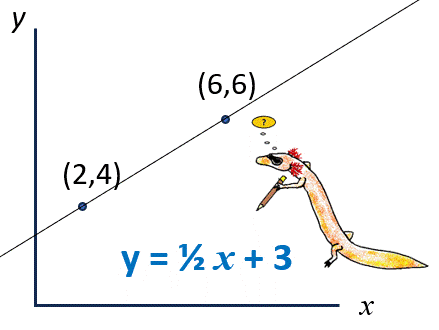
There are two main forms which are used to show linear equations:
Standard Form
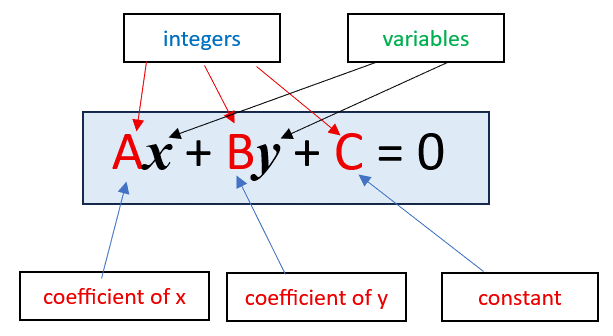
A linear equation can be written in the standard form:
Ax + By + C = 0
- where A, B and C are whole numbers
- x and y are variables
Slope-Intercept Form
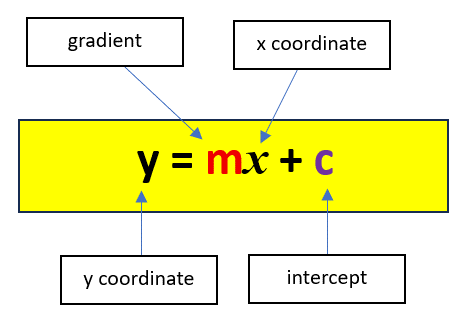
However, it is more commonly written in slope-intercept form:
y = mx + c
- m is the gradient or slope of the line
- x is the x coordinate and y is the y coordinate
- the point c is the y intercept where the line crosses the y-axis.
What are Parallel Lines?
Parallel lines are lines that go in the same direction. They never meet no matter how far they are extended.
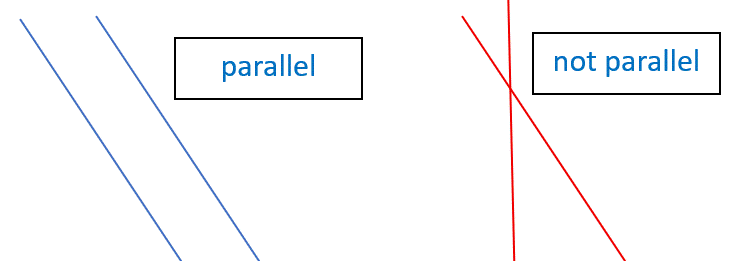
Many shapes like squares, rectangles, parallelograms, hexagons and rhombuses contain pairs of parallel lines.

How to find the Slope or Gradient (m) from two points or a line on a coordinate grid
If we are given a line or coordinates on a line instead of a linear equation, then our first task will be to find the slope.
Use the link below for help and support to find the slope from either a line on a coordinate grid or two coordinates on the line.
How do I know if two lines are parallel?
Two lines are parallel if they have the same slope or gradient.
If the gradient of the two lines is identical then the lines will never meet as they will be going up or down at the same rate.
This means that in order to find linear equations that are parallel we need to be able to find the slope of the linear equations.
What is the Slope of a Linear Equation?
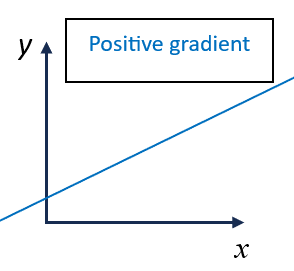
The slope of a line is also know as the gradient.
It is also the value of the letter m in the equation:
y = mx + c
There are several ways that we can find the slope (or gradient) of a linear equation:
- we can look at the equation itself which will show us the slope
- if we do not know the linear equation then we can look at two points on the line to find the slope
If you would like more information and support finding the slope of a linear equation then use the link below:
How to find Linear Equations that are Parallel
The slope intercept form of a linear equation is:
y = mx + c
where m is the slope or gradient of the line.
Two linear equations are parallel if they have the same slope or gradient.
This means that the value of m in both equations must be equal.
In other words, both equations need to have the same 'x' coefficient.
Examples of Parallel Linear Equations
- \[ y = 3x \] \[ y = 3x + 4 \] are parallel as they both have a gradient of 3
- \[ y = 5x + 7 \] \[ y = 5x - 4 \] are parallel as they both have a gradient of 5
- \[ y = 7 - 4x \] \[y = 2 - 4x \] are parallel as they both have a gradient of -4
- \[ y = {1 \over 2} - x \] \[ y = 6 - x \] are parallel as they both have a gradient of -1
- \[ y = {x \over 2} - 4 \] \[ y = {x \over 2} - 1 \] \[ y = {x \over 2} + {1 \over 4} \] are all parallel as they have a gradient of ½
Linear Equations that are NOT Parallel
If the gradient of two linear equations are different then the lines are not parallel.
All we need to do is to check the 'x' term and see if they are the same or different.
- if the 'x' terms are the same then the lines are parallel
- if the 'x' terms are different then the lines are not parallel
- \[ y = 2x \] \[ y = 3x - 8 \] are NOT parallel as they have gradients of 2 and 3 respectively
- \[ y = 5x + 7 \] \[ y = 9 - 5x \] are NOT parallel as they have gradients of 5 and -5
- \[ y = 7 - 3x \] \[y = 7 - 4x \] are NOT parallel as they have gradients of -3 and -4
- \[ y = 2x - 6 \] \[ y = 6 - {x \over 2} \] are NOT parallel as they have gradients of 2 and -½
How to find Linear Equations that are Parallel Examples
Example 1) What is the equation of the line that passes through point (7, 12) which is parallel to the line \[ y = 3x + 4 \]
This linear equation is already in slope-intercept form (which is the form we need).
The value of m is equal to the coefficient of the x-term which is 3.
So the gradient or slope of the line is 3.
So the equation of the line we need is: \[ y = 3x + c \]
To find the value of c, we substitute in the values of the coordinate which the line passes through which is (7, 12)
The coordinate (7, 12) has an x-value of 7 and a y-value of 12.
We susbtitute these values into our equation: \[ 12 = 3(7) + c \]
Simplifying this expression gives us: \[ c + 21 = 12 \] \[ c = 12 - 21 = -9 \]
So the equation of our line is: \[ y = 3x - 9 \]
Example 2) What is the equation of the line that passes through point (3, -4) which is parallel to the line \[ y = 12 - 5x \]
This linear equation is already in slope-intercept form (which is the form we need).
The value of m is equal to the coefficient of the x-term which is -5.
The gradient or slope of the line is -5.
So the equation of the line we need is: \[ y = -5x + c \]
To find the value of c, we substitute in the values of the coordinate which the line passes through which is (3, -4)
The coordinate (3 ,-4) has an x-value of 3 and a y-value of -4.
We susbtitute these values into our equation: \[ -11 = -5(3) + c \]
Simplifying this expression gives us: \[ c - 15 = -11 \] \[ c = -11 + 15 = 4 \]
So the equation of our line is: \[ y = -5x + 4 = 4 - 5x \]
Example 3) What is the equation of the line which passes through point (-5, 2) and is parallel to the line: \[ 2x + y - 5 = 0 \]
This linear equation is in standard form.
We need to change this into slope-intercept form to find the gradient.
We do this by moving the x-term and the number 9 to the right hand side of the equation.
\[ 2x + y - 5 = 0 \] Subtracting 2x and adding 5 to both sides of the equation gives us: \[ y = 5 - 2x \]
The value of m is equal to the coefficient of the x-term which is -2.
So the gradient or slope of the line is -2.
So the equation of the line we need is: \[ y = -2x + c \]
To find the value of c, we substitute in the values of the coordinate which the line passes through which is (-5, 2)
The coordinate (-5, 2) has an x-value of -5 and a y-value of 2.
We susbtitute these values into our equation: \[ 2 = -2(-5) + c \]
Simplifying this expression gives us: \[ c + 10 = 2 \] \[ c = 2 - 10 = -8 \]
So the equation of our line is: \[ y = -2x - 8 \]
Example 4) What is the equation of the line which passes through point (-1, 8) and is parallel to the line: \[ 18x - 3y + 12 = 0 \]
This linear equation is in standard form.
We need to change this into slope-intercept form to find the gradient.
We do this by moving the x-term and the number 9 to the right hand side of the equation.
\[ 18x - 3y + 12 = 0 \] Dividing all the terms by 3 gives us: \[ 6x - y + 4 = 0 \] Adding y to both sides of the equation gives us: \[ 6x + 4 = y \; so \; y = 6x + 4 \]
The value of m is equal to the coefficient of the x-term which is 6.
So the gradient or slope of the line is 6.
So the equation of the line we need is: \[ y = 6x + c \]
To find the value of c, we substitute in the values of the coordinate which the line passes through which is (-1, 8)
The coordinate (-1 , 8) has an x-value of -1 and a y-value of 8.
We susbtitute these values into our equation: \[ 8 = 6(-1) + c \]
Simplifying this expression gives us: \[ c - 6 = 8 \] \[ c = 8 + 6 = 14 \]
So the equation of our line is: \[ y = 6x + 14 \]
Example 5) A line passes through points (-2, 15) and (5, -13). A second line which is parallel to the first line passes through (3, 0).
What is the equation of the second line?
Our first job is to find the gradient of the first line.
The equation to find the gradient is:
\[ m = {(y_2 - y_1) \over (x_2 - x_1)} \]
Our two points are (2, -1) and (6, 11) so this give us:
- x1 = -2
- y1 = 15
- x2 = 5
- y2 = -13
This gives us:
\[ m = {(-13 - 15) \over (5 - (-2))} = {-28 \over 7} = -4 \]
This means that the gradient of the line is -4.
We only need to find the gradient for the first line, so can move on to the next part.
Now we will look at the second line which is parallel to the first line.
The gradient has to be the same as the first line, so the equation we need is:
\[ y = -4x + c \]
To find the value of c, we substitute in the values of the coordinate which the line passes through which is (3, 0)
The coordinate (3 , 0) has an x-value of 3 and a y-value of 0.
We susbtitute these values into our equation: \[ 0 = -4(3) + c \]
Simplifying this expression gives us: \[ c - 12 = 0 \] \[ c = 12 \]
So the equation of our line is: \[ y = -4x + 12 = 12 - 4x \]
Example 6) Find the equation of the line which is parallel to the line below and passes through point (3, 6).
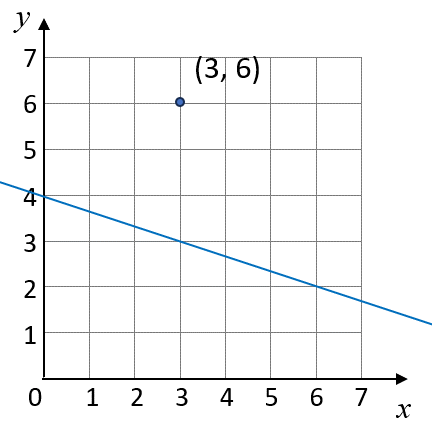
The first task is to find the gradient of the existing line.
The equation to find the gradient is:
\[ m = {(y_2 - y_1) \over (x_2 - x_1)} \]
We need to find two points which lie exactly on the line shown.
For this line, we are going to take points (0, 4) and (6, 2) so this give us:
- x1 = 0
- y1 = 4
- x2 = 6
- y2 = 2
This gives us:
\[ m = {(2 - 4) \over (6 - 0)} = {-2 \over 6} = -{1 \over 3} \]
This means that:
\[ y = -{1 \over 3}x + c \]
As we are only looking to find the gradient, we do not need to worry about finding the value of c for this line.
The value of m is the coefficient of the x term which is -⅓
So the gradient or slope of the line is -⅓
Now we will look at the second line which is parallel to the first line.
The gradient has to be the same as the first line, so the equation is:
\[ y = -{1 \over 3}x + c \]
To find the value of c, we substitute in the values of the coordinate which the line passes through which is (3, 6)
The coordinate (3 , 7) has an x-value of 3 and a y-value of 6.
We susbtitute these values into our equation: \[ 6 = -{1 \over 3}(3) + c \]
Simplifying this expression gives us: \[ c - 1 = 6 \] \[ c = 7 \]
So the equation of our line is: \[ y = -{1 \over 3}x + 7 = 7 - {1 \over 3}x \]
Linear Equations that are Parallel Worksheets
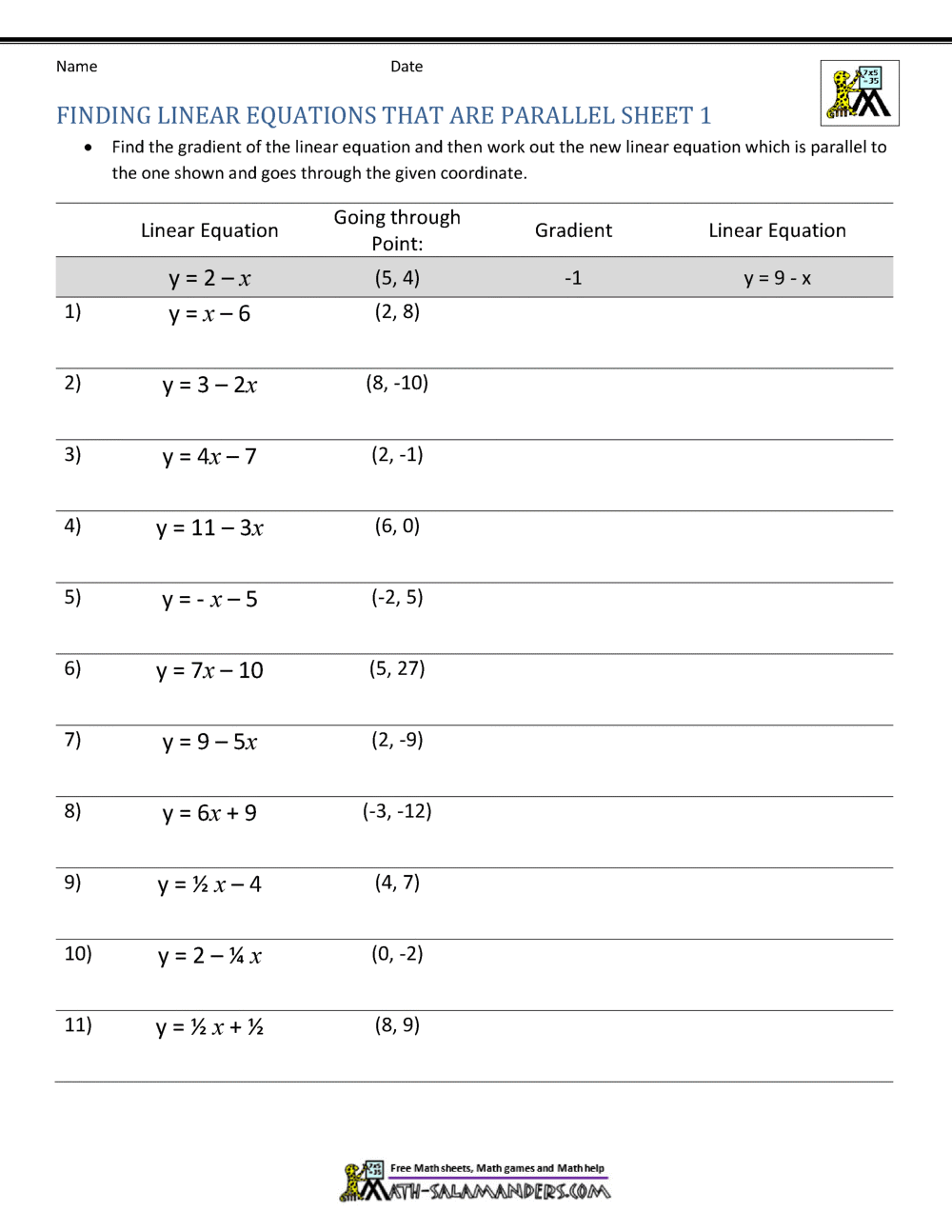
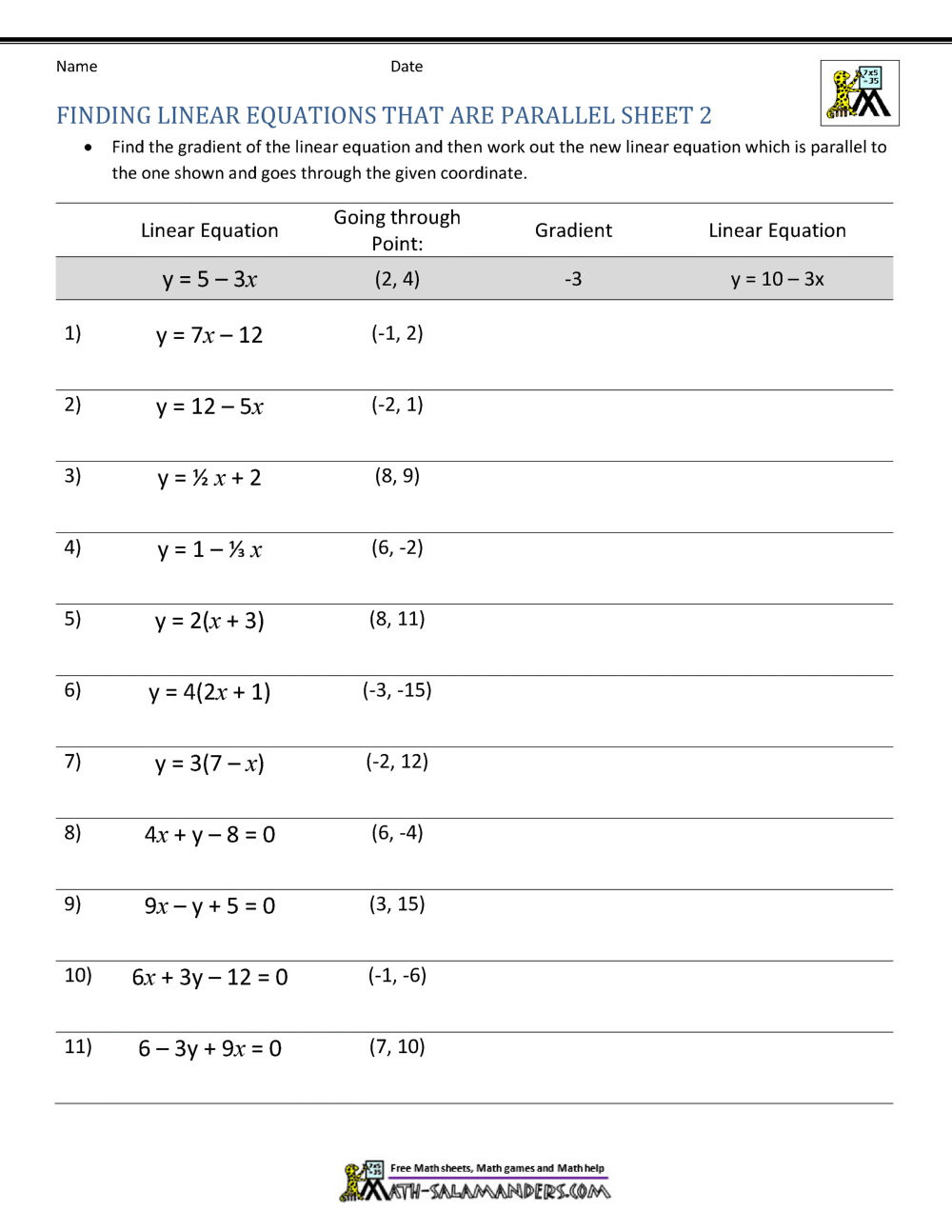
We have created a series of worksheets to help you practice finding linear equations which are parallel.
Each sheet involves finding the linear equation from a parallel linear equation and a point which the linear equation goes through.
- Sheet 1 involves finding a linear equation in slope-intercept form.
- Sheet 2 involves finding a linear equation in slope-intercept form and also standard form.
Linear Equation Calculator
Our Linear Equation Calculator will find a linear equation from two points and display the equation both in slope-intercept form and standard form.
You can easily use the calculator to find the slope (m) of the linear equation.
However the best thing about our calculator is that it takes you through all the steps needed to find a linear equation from two points.
More Recommended Math Worksheets
Take a look at some more of our worksheets similar to these.
Linear Equation with Two Points Support
If you need further support on solving linear equations, then try our dedicated support page.
On the page you will find:
- clear definitions and explanations how to find a linear equation from two points
- lots of worked examples
- practice worksheets
- link to our linear equation calculator
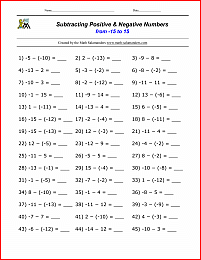
Negative Number Worksheets and Support
In order to find a linear equation from two points, you need to be proficient at adding and subtracting negative numbers.
Here are some of our resources which will help you to learn and practice these skills.


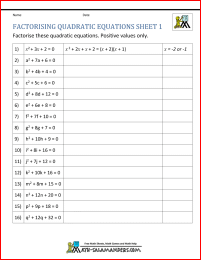
Factorising Quadratic Equation Worksheets
The sheets are arranged in order of difficulty to help introduce you into more complicated examples gradually.
Using these sheets will hopefully make factorising quadratic equations simple and straightforward.
The sheets cater for simpler and more complex quadratic equations.
How to Print or Save these sheets 🖶
Need help with printing or saving?
Follow these 3 steps to get your worksheets printed perfectly!
How to Print or Save these sheets 🖶
Need help with printing or saving?
Follow these 3 steps to get your worksheets printed perfectly!
Subscribe to Math Salamanders News
Sign up for our newsletter to get free math support delivered to your inbox each month. Plus, get a seasonal math grab pack included for free!

Math-Salamanders.com
The Math Salamanders hope you enjoy using these free printable Math worksheets and all our other Math games and resources.
If you have any questions or need any information about our site, please get in touch with us using the 'Contact Us' tab at the top and bottom of every page.
